World > South America > Central Andes > Peru > Choquiquirao

One of the best hikes in the world is the

Choquequirao Trek

Note: In 2006 the Instituto Nacional de Cultura (INC) proposed a fee for the following treks: Salkantay, Choquechirau and Espiritu Pampa. Rumour has it that the cost for Salkantay and Choquequirau will be 120 soles. The Cusco SAE office will put forward a formal complaint to the INC. (email if you have more information on this)

Note: Entrance tickets for Machu Picchu are no longer available at the gate. Get them in advance.

  • often spelled Choquequirau or Choquiquirao (Choquiquirao is perhaps the most common)

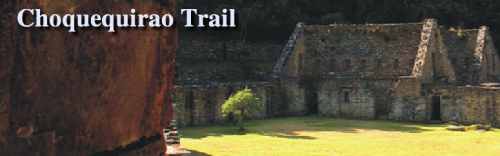
Choquequirao is a enigmatic ruined Inca city even less accessible than Machu Picchu. One day it will draw hordes of tourists but for now it is still little visited. The ultimate itinerary is to hike to Choquequirao and continue to Machu Picchu via Aguas Calientes.

We should rate this trek strenuous, difficult & dangerous. But it is rapidly getting easier as more hikers tramp these trails.

WHY WE LIKE THIS HIKE

PERU, all things considered, offers the best alpine hiking in the world.

The main reason we like Choquequirao is that it is not the crowded, over-regulated Inca Trail.

  • Choquequirao is far more remote, difficult & rugged
  • Choquequirao ruins were fantastically built on a high mountain ridge
  • climb high on sacred Salcantay, the highest mountain in the region, then descend through cloud forest to humid jungle
  • more elevation change, greater variety of habitat than the Inca Trail
  • more contact with the indigenous Quechua people
  • good chance to see condors
  • less expensive than the Inca Trail per day
  • new the recently discovered "llamas del sol" (photos ) at the ruins
  • ... add a comment here

Choquequirao - image Hotel Casablanca Cusco 

CONSIDERATIONS

Inevitably this trek will be made official. Regulations and restrictions imposed. Get there soon. It will change for the worse.

  • this trek is rapidly gaining popularity
  • basic supplies & treats are available at many points. This is not a wilderness area. Carry cash.
  • biting insects, including ants, are a big concern
  • trekking guidebook not available (as of the most recent date of publication of this page) — you need a guide or arriero (mule driver)
  • evacuation is difficult in some sections
  • no rescue service. You are on your own.
  • sections are very steep and can be muddy
  • did we mention it's steep? This was an elevation gain record for this hiker (we climbed from the river to the ruins in one day)


Choquequirao - maps InkaNatura 

  • some campsites, toilets, showers and food available en route
  • ask permission of local people before camping near them. There is sometimes no camping fee, but it is courtesy to buy a soft drink, beer or snacks in lieu.
  • best months the May through September dry season
  • weather will be variable
  • acclimatization in Cuzco 3326m (10,912ft) is advised though much of this trek is at lower elevation
  • 13-hour long nights in the tent
  • temperatures can fall below freezing at night near Salcantay
  • be prepared for snow or sleet — and later humidity & rain
  • though you can travel Peru for as little as US$20 / day, Machu Picchu is expensive! Check with travellers in Peru when you get there for up-to-date costs.
  • entrance for Choquequirao is inexpensive (about US$3) but Machu Picchu costs about US$20
  • ... add a comment here

An easier-to-organize Inca Trail alternative is Salcantay.

LOGISTICS

  • the trailhead Cachora is a tiny agricultural town rapidly becoming a hiking centre as more trekkers arrive
  • trails are confusingly signed, or not marked at all. Hire a guide.

Several different itineraries to Choquequirao are recommended:

  1. Cachora>Choquequirao>Cachora (4 nights)
  2. Cachora>Choquequirao>Yanama>Huancacalle (7 nights minimum) includes a 4600m pass
  3. Cachora>Choquequirao>Yanama>Tatora>Santa Teresa or Llactapata>Aguas Calientes>Machu Picchu (7 nights minimum) includes a 4650m pass

Itinerary 3 is the best hike! Do this one if you can.

Itinerary 1 is comparatively easy. You could do it on your own if you can handle over 1800m vertical carrying your pack.

This trek is so new, and the cost of pack animals so reasonable, that we recommend you hire at least an arriero (mule herder) & burros to carry your pack up & down these mountains, especially for either itinerary 2 or 3. It is easy to hire pack animals in Cachora.

If you sign on with a trekking company, they will organize transport to the trailhead.

If travelling to Cachora independently:

  • get any bus Cuzco to Abancay
  • ask to get out at the turn-off to Cachora (about 4 hours from Cusco)
  • walk down to the village (90 minutes) and stay in one of several inexpensive basic hostels overnight. (Try Los Tres Balcones .)
  • hire a guide/arriero and pack animals
  • start your trek next morning
  • ... add a comment here

INDEPENDENT OR GUIDED?

Regardless of which itinerary you choose, safest is to sign on with a reputable adventure travel company:

Independent hiking is more challenging, but possibly more fun. And it will be less expensive.

  • you need to speak Spanish
  • you can organize your trip personally with a guide in Cachora
  • if you insist on hiking without pack animals, best hike only to the Choquequirao ruins and back
  • ... add a recommendation here

If you hire in Cachora, expect to pay at least US$10 / day for an arriero & US$6 / day / burro. Add at least a 25% tip if you are happy with the service. A Peruvian Spanish speaking guide will cost perhaps $50 a day. Prices will increase as more trekkers choose this hike.

We hired our own animals & mule driver from Dayme Lopez in Cachora and recommend him wholeheartedly.

  • Dayme Lopez (you may see Dayme mistakenly referred to as Dayne Suucahuaman from a confused reference in an SAE trip report). Try to telephone Dayme in advance at 005183-832034 — but do not count on reaching him as this is a public phone in Cachora. His wife is Marce Lopez. You may need to simply ask for Dayme when you get to Cachora.
  • ... add a guide recommendation here

LOCAL INFORMATION

  • South American Explorers Cuzco  is your first and best source of information. Look for hiking partners through the SAE website or by posting a note at their Cuzco clubhouse.

BEST HIKING GUIDEBOOKS

Lonely Planet Trekking in the Central Andes 2003  is our favourite but this edition does not include the Choquequirao trek.

The best official guidebook is Footprint Cusco & The Inca Heartland, 3rd Edition .

But South American Explorers publish a useful small booklet called Alternative Inca Trails Information Packet. You can have it emailed to you or buy it in Cuzco.

Other guides:

BEST MAPS

If you are only hiking to the ruins and back, you can make it without a map. (We did manage to get lost in the maze of trails exiting Cachora.)

There is no good trekking map for the longer routes past the ruins, so far as we know. Hire a guide / arriero for those treks. In addition, you should confirm the best route with locals & with guides from other groups while on the trail. Conversational Spanish is a big advantage.

The best of the poor maps is:

  • IGN 1:100,000 Machupicchu (sheet 2344, 27q) available (when you get to Cuzco) from the South American Explorers Club.
  • ... add a recommendation here

BEST WEBSITES

BEST PHOTOS & TRIP REPORTS

Definitely check the top report, trekking without guide or pack animals.

OTHER RECOMMENDED BOOKS


Choquequirao - George Novak


Looking for more? Use Google, the best search engine.

Google

World > South America > Peru > Choquiquirao


E-mail the BestHike.com editor with your feedback.

advertise on this page 

This page last modified Saturday, November 1, 2008.