|
|
One of the best hikes in the world is
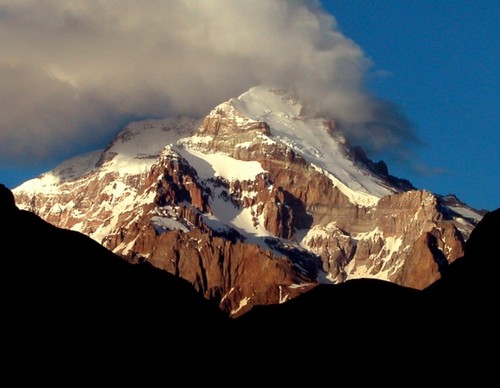
Aconcagua
Do you know this hike?
This page is a "stub". You can expand it by emailing suggestions in the appropriate sections below. Our editors will add your comments. Thanks!
Treks in this region known as:
- Horcones Valley to Plaza Francia (Horcones Valley route)
- Vacas Valley to Plaza Argentina (Vacas Valley or Polish Glacier route)
WHY WE LIKE THIS HIKE
ARGENTINA is one of our favourite countries
- Aconcagua 6962m (22,841ft) is the highest peak in the world outside Asia
- it's one of the 7 summits, the highest peaks on each continent
- this page does not detail the climb, rather it describes treks in the Aconcagua region
- some mountaineers trek for acclimatization before making a summit attempt
- hikers love Mendoza, Argentina, the jumping off point
- easy access too from Santiago, Chile
- no mosquitoes, snakes or dangerous animals
- this is expensive, difficult hiking at altitude. Head for Patagonia instead if this the challenges of Aconcagua deters you.
- ... add a comment here
CONSIDERATIONS
Warning: In 1996, the year of the much publicized "Everest Disaster", when 13 people were killed, more died climbing Aconcagua. It is easy for inexperienced hikers to walk high, then get in serious trouble. Be cautious.
- altitude sickness is your biggest concern
- acclimatization is essential. Spend as many days as possible at high altitude before approaching Aconcagua. Starting from Santiago, Chile (500m) is a bad idea.
- crazy, unpredictable weather is your second biggest concern
- wind is near constant during the summer
- temperatures down to -20C (-4F) are possible at base camps though you are more likely to get -3C (26F) nights and up to 27C (80F) days.
- hypothermia is a real risk if you do not have the right gear and clothing. You need a strong tent & good tie-downs.
- wind & cold drives some hikers back to Mendoza
- if you have never experienced wind chill, this is the trek for you
- be prepared for heavy snow
- sun protection, lip-healing ointment essential
- don't skimp on the ibuprofen and aspirin
- many carry nifedipine in case of pulmonary oedema
- some carry Diamox for alleviating altitude sickness symptoms but its use is controversial
- Dec-Feb is peak climbing season with the best weather
- trekking is recommended Nov-March. In fact you may want to avoid Dec & Jan as the region is crowded, prices go up and pack animals are booked.
- river crossings too can be fatal though bridges are being built & improved
- base camps are staffed by radio-equipped Rangers
- lower elevations are relatively dry
- if you use pack animals, store gear in sturdy duffle bags that can be locked
- expensive permits are required for both trekking (US$50-70) & climbing ($US400) / week or more! Fitz Roy in Patagonia, by comparison, is free and at much lower altitude.
- regulations change frequently
- most hikers buy trekking permits in Mendoza, in person
- 90% of those buying climing permits are foreigners; American, German, UK, etc. but trekkers are primarily Argentinian
- be aware if you fly into Chile that some Nationalities must pay an often unexpected "reciprocation" fee (US50 - $100) paid once every 10 years
- travel & trekking insurance is highly advisable as you must pay if you are rescued from the Park
- butane cartridges are available in Mendoza, but white gas is easier to find and works better in cold conditions
- trekkers may be required to carry out their faeces
- ... add a comment here
Accommodation & tourist infrastructure in Mendoza are excellent. Be wary of pickpockets we had daypacks stolen from an internet cafe.
ROUTE
Aconcagua by Jim Ryan is primarily a climbing guide, but also recommends two routes for hikers:
- trek Horcones Valley to Plaza Francia (65km round trip) on the "Normal route" or "Horcones Valley" route from the Puente del Inca trailhead 2725m (8,900ft)
- trek the Vacas Valley to Plaza Argentina (42km) on the Polish Glacier route from the Puente de Vacas trailhead and continue as far as you wish, even as far as a hut at Independencia (6250m) if weather and altitude sickness allow
The Vacas route is arguably more scenic. But there is a basic hotel and services at Plaza de Mulas 4370m (14,000ft) on the shorter, more popular Horcones valley route.
There are other possible routes, of course. Get a copy of Jim Ryan's guidebook Aconcagua if you want to plan a more complicated itinerary. We'd love to simply circumambulate the mountain, for example, via Independencia.
The Andes, A Trekking Guide lists the same basic Aconcagua treks for independent hikers in this way:
- 3-day walk (32km) to the South Face
- 6-day walk (80km) up the Vacas Valley
INDEPENDENT OR GUIDED
Browse the options above to find a guided package which suits you. We have not personally used any of these companies. Most are primarily climbing guides who sometimes guide trekkers as a sideline.
First timers to Aconcagua should definitely hire a guide, especially those who do not speak Spanish. Pack animals are recommended as well.
At minimum and we are courageous enough to recommend this option travel to one of the trailheads and hire pack animals and an arriero (mule driver) on the spot. This is cheaper than signing on with a full guided tour but much safer than going it on your own.
Experienced high altitude hikers can certainly do Aconcagua independently.
LOGISTICS
If you sign on with a guided trip logistics will be organized for you. This section is for independent hikers.
Aconcagua is conveniently close to paved highway 7 between Santiago, Chile and Mendoza, Argentina
Most hikers provision and start from Mendoza, Argentina, one of the most popular tourist destinations in Argentina. Buy your trekking permit there in person at the Direccion de Recursos Naturales Renovables in Parque General San Martin. Cost varies with the amount of time you want to spend in the park. Both 3 and 7 day trekking permits are available.
You can start from Santiago, Chile as well if you have your trekking permit in hand. The summit is only 12km from the Chilean border.
It is easy to bus from Mendoza to one of two trailheads:
- Punta de Vacas (Vacas Valley route)
- Puente del Inca (Horcones Valley route)
Puenta del Inca, Argentina 186km from Mendoza, 169km from Santiago is the more popular trailhead or the two. If you need to hire pack animals at the trailhead, it is easiest in Puente del Inca.
- the closest international airport is Santiago, Chile. We would fly in to Argentina instead, if we could, though there are no international flights to Mendoza.
- purchase fuel & rent gear if needed in Mendoza
- if looking for hiking partners check with South American Explorers Buenos Aires
or ask around at the hostels in Mendoza
- ... add a comment here
LOCAL INFORMATION
BEST TREKKING GUIDEBOOKS
- Cicerone Aconcagua
Jim Ryan, 2005, though a climbing guide, is still the best guidebook for hikers
- The Andes, A Trekking Guide
John & Cathy Biggar, 2001 has a nice summary of the most popular routes
- Aconcagua
R.J. Secor, 2004 was the top climbing guidebook until publication of Ryan's book
- Aconcagua: Summit of South America
Rucksack Pocket guide, Harry Kikstra, is a remarkably good resource in a tiny package.
- Adventure Handbook - Central Chile, Schubert & Sieber, 2002
- Bradt Chile & Argentina. Backpacking & Hiking
Tim Burford, 2001
- ... add a recommendation here
We are still waiting on a dedicated trekking guide to this region. (Perhaps you should write one.)
BEST TRAVEL GUIDEBOOKS
OTHER RECOMMENDED BOOKS
BEST MAPS:
You can purchase a variety of maps at the permit office in Mendoza and shops in town. The accuracy of many is questioned. Camps have been moved over the years.
Browse on-line maps:
BEST WEBSITES
The most impressive website is Aconcagua.com. Take some time to browse the many pages and links.
BEST PHOTOS & TRIP REPORTS
|